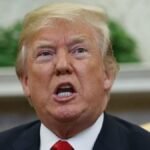




Donald Trump, 79, reportedly threw such a severe tantrum during a high-stakes rescue operation in Iran that his own aides had to physically remove him from the room. Senior White House officials told the Wall Street Journal that the president had never behaved like this before during a national security crisis. Insiders who witnessed the freakout said it was unlike anything they had ever seen inside the White House. The extraordinary episode is now raising serious questions about how the commander-in-chief conducts himself when things go wrong.
The crisis began when a U.S. F-15E Strike Eagle was shot down over Iran and two American airmen went missing. The moment Trump received that news, he went into what officials described as a frenzied, panicked state. He began screaming at aides and could not be calmed down. His reaction quickly became a problem bigger than the crisis itself.
His hours-long tirade became such a hindrance to the people managing the situation that aides made the extraordinary decision to bar him from the crisis briefing room entirely. Rather than keeping him in the loop in real time, they chose to update him at set intervals instead. Two people familiar with the episode told the Journal they described it plainly as a “freak-out.” It was, by any standard, a stunning moment — a sitting president booted from his own briefing.
Even before the airmen went missing, Trump had already been consumed by fear of repeating one of the most damaging moments in modern American presidential history. He was fixated on the 1979 Iran Hostage Crisis and the failed rescue mission under President Jimmy Carter that helped end Carter’s chances at re-election. That fear was not abstract — it was personal and constant.
“If you look at what happened with Jimmy Carter…with the helicopters and the hostages, it cost them the election,” Trump said in March, according to the Journal. “What a mess.”
Trump was terrified that the two missing airmen could become his own version of that defining failure. He feared this single moment could define his entire presidency and make him look weak in front of the world. That fear, rather than steady leadership, appeared to be driving his every reaction.
He demanded the U.S. military launch an immediate rescue mission. His aides pushed back hard, warning that American troops had not had boots on the ground in that region of Iran since the 1970s. The military needed time to assess the terrain before putting soldiers in harm’s way. Trump did not want to hear it.
The pilot of the downed aircraft was recovered later that same day. But a tense, two-day race then followed, with U.S. forces competing directly against Iranian forces to reach the second crew member first. American troops eventually won that race and brought the airman home safely.
While he waited for updates, Trump repeatedly raged throughout a nearly empty West Wing over rising gas prices and America’s European allies. National average gas prices had surged to $4.09 per gallon, adding to his visible agitation. He was also furious that European nations had refused to join the surprise war he and Israel launched against Iran on February 28. The West Wing, aides said, felt like a pressure cooker.
Hours after learning of the successful rescue that Saturday, Trump kicked off Easter Sunday by posting a profanity-filled message on Truth Social. He demanded that Iran reopen the Strait of Hormuz, the critical waterway through which roughly one-fifth of the world’s oil supply flows.
“Open the F—n’ Strait, you crazy b——ds, or you’ll be living in Hell,” Trump wrote.
He then closed the post with “Praise be to Allah. President DONALD J. TRUMP.”
The sign-off detonated a firestorm almost immediately. Many within Trump’s own Christian base were outraged that he had praised Allah on one of Christianity’s holiest days of the year. The backlash was swift, loud, and came from people who had long supported him.
Trump later admitted to an adviser that he had written the post deliberately. He said he wanted to appear “unstable and insulting” in order to frighten Iran into coming to the negotiating table. But even he seemed rattled by the fallout, reportedly asking advisers, “How’s it playing?” shortly after the post went live.
Rather than dialing back, Trump escalated further just days later. He posted another message on Truth Social threatening that “a whole civilization will die tonight” in Iran if his demands were not met by Tehran. It was the kind of language that alarmed foreign policy experts and rattled global markets simultaneously.
White House Press Secretary Karoline Leavitt pushed back on the Journal’s reporting, insisting to reporters that Trump “remained a steady leader our country needs.” She added that “President Trump campaigned proudly on his promise to deny the Iranian regime the ability to develop a nuclear weapon, which is what this noble operation accomplishes.” The White House did not directly address the claim that Trump had been removed from the briefing room.
On Friday, Trump boasted to reporters that Iran “had agreed to everything” and declared the standoff over the Strait of Hormuz finished, calling it “a great victory.” Less than 12 hours later, an Iranian Revolutionary Guard ship fired on a tanker in the Strait of Hormuz.
As of today, Trump has extended the ceasefire indefinitely, but a final deal remains completely out of reach. Iran has since seized additional vessels in the Strait, and peace talks have stalled with no breakthrough in sight. The gap between Trump’s public bravado and the private chaos unfolding inside the White House has never looked wider.