







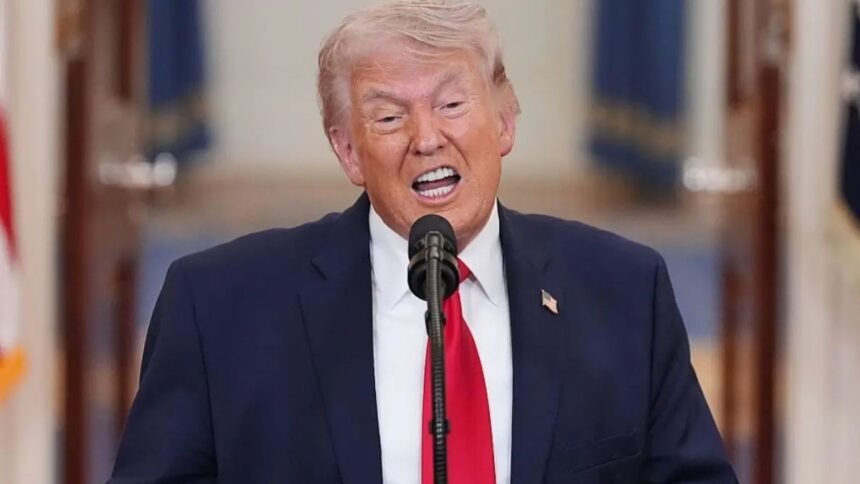
Donald Trump built a life shaped by privilege and power, far removed from the everyday routines most Americans know. That distance has always been part of his story. But what happened in Las Vegas last week made it very hard to ignore, and even harder to explain away.
At a tax roundtable in Nevada, Trump stood before a crowd to read from a prepared statement about the “Big Beautiful Bill,” a sweeping tax law signed in July 2025. He bragged about how it has slashed taxes for working Americans across the country. He named the businesses that stood to benefit, including restaurants, dry cleaners, and corner stores.
Then he stopped cold.
“What is a corner store?” he asked out loud, right in the middle of his own prepared speech. “I’ve never heard that term. I know what a corner store is, but I’ve never heard it described as a corner store.” He then turned and snapped, “Who the hell wrote that, please?”
The room laughed. But the moment did not stay in that room for long.
Trump: “Millions of American small businesses, including corner stores. What is a corner store? I’ve never heard that term. I know what a corner store is but I’ve never heard it described– a corner store. Who the hell wrote that?” pic.twitter.com/meTSMHxdX0— Aaron Rupar (@atrupar) April 17, 2026
That one unscripted pause, that single confused question about a phrase every working-class American has used their whole life, said more than any policy speech could. For millions of people watching the clip online, it felt less like a gaffe and more like a reveal. The word “corner store” had never truly crossed his radar, and that said everything.
Television personality Don Lemon shared the clip on Instagram, writing, “Trump is from NYC and doesn’t know what a corner store is.” For anyone who has ever lived in New York, that statement is almost impossible to process. Corner stores, known locally as bodegas, sit on virtually every block in the city and have done so for generations.
“Happy Days” actor Henry Winkler added just four words, tweeting, “In touch with America.” It was short, sharp, and the internet ran with it. Their responses helped push the exchange from a routine appearance into a viral cultural moment.
Everyday users filled in the rest of the story. One commenter wrote, “In a stunning moment of ignorance, Trump reveals that he does not know what a corner store is.” Another person added, “I wouldn’t normally say this, but hopefully he knows what a bodega is.” The responses kept coming, wave after wave, each one pointing to the same uncomfortable truth.
“Despite being from NYC, Donald Trump doesn’t know what a corner store is,” someone said in disbelief. Another wrote, “In New York, they call them bodegas, but still, it should not have been an alien term.” One person noted, “The rambling senior citizen babbles nonsense on TV. Fixed the article’s title.” Finally, one person blasted, “He’s totally clueless about how the majority of American citizens live.”
The corner store moment did not appear out of nowhere. It fits a growing pattern of comments that have left people scratching their heads.
During a separate exchange about rising costs, Trump said something that turned heads all over again. “The new word is ‘affordability,’” he explained. “Another word is just ‘groceries.’ You know, it’s sort of an old-fashioned word, but it’s very accurate.” The comment spread across social media for days, with users debating whether it showed confusion, optimism, or simply a worldview shaped entirely by a life of extreme wealth.
“Groceries” is not an old-fashioned word. It is not a new word either. It is what millions of American families say every single week when they are trying to figure out how to feed their children on a tight budget. Calling it old-fashioned, in the same breath as calling it very accurate, felt like something a person says when a word has never truly been a part of their daily life.
Then came the marble bathroom discussion, a detail that took on real symbolic weight once photos circulated of a polished marble and gold renovation inside the White House’s Lincoln Bedroom. For families deciding between paying rent or buying groceries that week, the image was impossible to ignore. The contrast between the gleaming White House renovation and the daily financial pressure most Americans feel was not subtle at all.
The president, who built his brand on real estate expertise, appeared out of touch when discussing one of the biggest financial decisions ordinary Americans face. While pitching a proposed 50-year mortgage, Trump reduced the entire concept to a single dismissive line. “All it means is you pay less per month,” he said, as if that were the whole story.
Fox News host Laura Ingraham pressed him directly, asking whether spreading a home loan across five decades was really a good idea. “It’s not even a big deal,” Trump insisted. “You go from 30 to 50 years, you pay something less per month. It might help a little bit.” What he left out is the part that matters most to actual buyers.
Families locked into a 50-year mortgage would pay dramatically more in total interest over the life of the loan. That turns what sounds like monthly relief into a decades-long financial burden. For Americans already stretched thin by inflation, rent, and food prices, a 50-year mortgage is not a helping hand. It is a debt trap dressed up in friendly language.
Recent polling shows that Trump’s standing has been slipping even among white working-class voters, one of his most reliable groups. A 26-point swing in his approval rating among that group has been reported in recent months. The corner store moment may seem small on the surface, but small moments have a way of crystallizing much larger truths at exactly the wrong time.
The viral reaction was never really about the vocabulary. Nobody expects a president to be a walking dictionary. What people reacted to was what the confusion revealed, a version of American life so comfortable, so insulated, and so far removed from the everyday, that even the most familiar phrases from working-class neighborhoods feel completely foreign. For millions of Americans who grew up shopping at corner stores and counting coins at the register, the moment did not land as funny. It landed as a mirror. And the internet made absolutely sure the world got a good, long look.