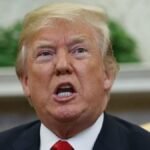
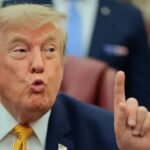


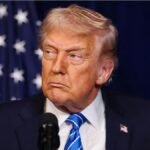

President Donald Trump walked into last Friday’s interview on a Wisconsin farm completely unprepared for what was coming. NBC’s Kristen Welker, a Black journalist and moderator of “Meet the Press,” sat across from him against a backdrop of hay bales and a tractor in Chippewa Falls, Wisconsin. What was supposed to be a routine sit-down quickly became something the White House clearly did not see coming.
Welker had one question Trump clearly did not want to answer. She asked him, calmly and repeatedly, what evidence supported his claims that elections are rigged and that January 6 rioters were ushered into the U.S. Capitol by law enforcement. Trump, completely triggered from the opening exchange, either could not or refused to answer directly.
With every follow-up question, the exchange grew hotter and more personal. The president stopped engaging with the substance of the interview and began attacking Welker instead. He ultimately cut the interview short, ripped off his microphone, and stormed away in full view of everyone in the room.
The moment became the defining image of Trump’s latest “Meet the Press” appearance. He repeatedly failed to back up his baseless assertions with any real evidence. Each time Welker pressed him, the answers grew shorter and the outbursts grew louder and more erratic.
The interview was covered extensively after it aired on Sunday, having been recorded on Friday, June 5, ahead of a political rally with farmers in Chippewa Falls. Torrential rain pounded the roof of the farm throughout the conversation, interrupting the exchange multiple times with loud thunder and wind. Despite the weather chaos, Welker stayed locked in and focused on the facts.
The wide-ranging interview touched on Trump’s ongoing conflict with Iran, the U.S. economy, the upcoming midterm elections, and a controversial proposal known as the “anti-weaponization” fund. The nearly $1.8 billion fund was designed to compensate people who claimed they were unfairly targeted by government prosecutions. The proposal drew bipartisan outrage and was effectively shelved after legal challenges and opposition from lawmakers.
Trump made clear on camera that he still supported the concept. “If it was up to me, I’d pay them the kind of money that they deserve,” he said. “If they get it approved, that’s great. If they don’t get it approved, I’d be disappointed.” It was a striking statement for a sitting president to make about a fund that had already been legally rejected.
Welker then pushed on a deeply uncomfortable detail. She asked whether people convicted in connection with the January 6 Capitol attack, including those who pleaded guilty to assaulting police officers, could receive money from that fund. Trump declined to rule it out and defended many of those involved in the riot.
“The people were destroyed by dirty cops and by weaponization,” Trump said. “Many of those people should be compensated.” He also repeated his claim that some rioters were “being ushered into the building” by law enforcement, going further to claim that FBI agents directed them inside.
According to NBC News fact-checkers, there is no evidence that any FBI special agents ushered rioters into the Capitol. Four confidential informants did enter the building, but they were not directed to do so by the bureau. Welker told Trump plainly on camera that no such evidence exists.
The conversation grew even more contentious when Trump pivoted to election integrity. He claimed once again that the 2020 election had been “rigged” and argued it was “happening again right now in California,” where ballot counting had continued for several days after the state’s primary. Under California law, mail ballots postmarked by Election Day can legally arrive days later and still be counted. Welker stated clearly there was no evidence of fraud in the California contest.
Trump pushed back anyway. “All I have to do is look,” he said. Welker did not flinch. “But that’s not evidence,” she replied. That single exchange captured the entire dynamic of the interview in two short lines.
The back-and-forth visibly irritated the president. He stopped answering questions entirely and turned his fire toward Welker and the press. “They’re crooked, just like you’re crooked, your press is crooked. And ‘Meet the Press’ is crooked,” he said. Welker stayed composed: “To be fair, I’m not crooked. But let’s continue.”
Trump did not continue. “You’re either crooked or you’re stupid,” he snapped. “You play right into their hands with this crap. You know that these elections are rigged. Your network knows that they’re rigged.” He then expanded his attacks to ABC, CBS, and CNN in the same breath, calling NBC a “one-sided crooked network.”
Then the interview ended. “Sorry. Let’s call it quits because I’ve had enough. Thank you, darling. Have a good time,” Trump said, pulling off his microphone and standing up. Welker pushed back immediately. “I traveled all the way to Wisconsin for this interview,” she said. Trump walked out of the room anyway, delivering one final line on his way out: “A country can never be great with a dishonest press.”
View on Threads
The reaction online was immediate and electric. Viewers flooded social media with sharp, emotional responses focused on Trump’s refusal to provide evidence and his decision to walk out when finally challenged. The clip spread rapidly across platforms, racking up millions of views within hours of the Sunday broadcast.
One commenter wrote: “I despise this motherf—er with the heat of a trillion suns. She tried to push back, but I wish she had said, ‘You saying it doesn’t make it true.'” The raw frustration in that comment captured exactly how millions of people watching at home were feeling. It was the kind of outrage that does not stay quiet.
Another viewer remarked: “This is so hard to watch. He is an absolute a— to her. Spouting lies and getting angry that she doesn’t back down.” The comment resonated widely because it named something many people felt but struggled to put into words. Watching a sitting president berate a journalist for simply asking for evidence is not normal, and viewers knew it.
A third person argued: “Every true journalist should press him relentlessly on his corrupt, totally untruthful, sociopathic, unconstitutional, and lawless presidency. When Trump walks out on an interview, America and the world win. He can’t argue the facts with nothing but lies.” It was a sentiment that spread fast and gathered thousands of likes within the first hour. For many online, Welker had done exactly what good journalism is supposed to do.
The walkout added to a growing and well-documented pattern of Trump clashing publicly with female journalists. In recent months, he has had heated exchanges with Bloomberg’s Catherine Lucey, ABC’s Rachel Scott, MSNOW White House reporter Akayla Gardner, and CNN’s Kaitlan Collins. The list keeps growing longer with each passing month and each new confrontation.
Others online raised a harder, more complicated concern about press access. One commenter wrote: “Problem is, push him hard and he then cuts access. Maybe it’s best he sticks with Fox and Newsmax, but then we don’t get to see him saying the silent part out loud.” It is a tension every reporter covering this White House knows all too well. There is no clean answer, only the difficult choice between access and accountability.
Despite the explosive ending, Welker later told viewers that she and Trump had spoken the following day and maintained a cordial relationship off-camera. She confirmed that the president had agreed to sit down for another “Meet the Press” interview in the future. For a man who just called her “crooked or stupid” on national television, that confirmation was remarkable. And on Sunday in Wisconsin, against a backdrop of rain and hay bales, Kristen Welker showed the entire country exactly what happens when someone simply refuses to let Trump off the hook.