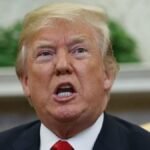

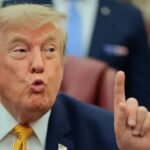




President Donald Trump made a very public and very desperate plea to Israeli Prime Minister Benjamin Netanyahu on Sunday. He told Netanyahu not to retaliate against a fresh wave of Iranian missile strikes. Within hours, the whole world watched as that plea fell completely flat.
Just hours before reaching out to Netanyahu, Trump had told the Financial Times with total confidence, “I call the shots. I call all the shots. [Netanyahu] doesn’t call the shots.” That bold claim aged poorly, and it aged very fast.
“I am going to call Bibi right now and tell him not to retaliate,” Trump told Axios. “Each of them had their fun. Israel had its strike, and Iran had its strike. We don’t need another one.”
In a separate call with Fox News, the president went even further. “What I would suggest to Iran: You’ve shot your missiles. That’s enough — get back to the table and make a deal,” he said. It was one of the most public and direct pleas any sitting American president had made in the middle of an active military conflict.
Viewers and readers couldn’t believe what they were watching. A sitting American president, 79 years old, was publicly urging a foreign leader to stand down in real time. The scene looked totally desperate to many observers following the story around the world. And yet, despite all of it, the plea changed absolutely nothing on the ground.
Despite Trump’s insistence that a peace deal was “very close,” Netanyahu quickly moved ahead with fresh strikes on Iran. Tehran had already launched missiles at Israel in retaliation for Israel’s earlier bombing of Beirut. Now the cycle of violence was spinning faster than any diplomatic effort could slow it down.
The Iranian Revolutionary Guard Corps, cited by Iranian state media, confirmed that explosions rocked the cities of Tehran, Tabriz, and Isfahan early Monday morning. Airports across western Iran were quickly placed into shutdown mode. Iran said “air-launched ballistic missiles” were used in the strikes, marking a serious and deliberate escalation.
No deaths were reported in the attacks. Still, the images coming out of Iran were deeply alarming, and the message they sent to the world was unmistakable. Netanyahu had simply ignored Trump’s call and acted entirely on his own terms.
The Israel Defense Forces confirmed early Monday that attacks had taken place but offered no further details. That brief, tight-lipped statement from the IDF said just as much as a lengthy press conference ever could. Israel had moved forward, and no amount of phone calls from Washington had stopped it.
Trump had already expressed frustration earlier in the week, saying he was “not happy” about Israel’s strikes in Lebanon. He also admitted that those strikes were “not coordinated with the U.S.” That was a remarkable thing for any American president to say publicly about a close ally, and it exposed just how limited Washington’s influence had become.
The escalation hit at perhaps the worst possible moment for the White House. Trump had been loudly and repeatedly insisting that a major breakthrough in peace talks was coming, possibly as early as this week. That confidence now looks painfully misplaced, and the gap between the president’s words and reality has never looked wider.
“I don’t want it to blow up because of what is happening now,” Trump told Axios, in a rare moment of visible frustration. The president who declared he called all the shots was now watching the situation spiral far beyond his reach. For a leader who has built his entire brand on control and leverage, this was a stinging and very public setback.
The fallout didn’t stay limited to diplomatic embarrassment. Global financial markets reacted with immediate alarm, with Asian stocks tumbling sharply at Monday’s open. Investors grew increasingly nervous about how U.S. markets would respond once trading began. The renewed fighting had reminded the world just how fragile the current situation really is.
Energy markets were already under severe pressure before this latest round of strikes. The conflict has continued to batter the Strait of Hormuz, the narrow but critical waterway through which roughly 20 million barrels of oil pass every single day. Any disruption to that corridor sends immediate shockwaves through the entire global economy, and this week was no different.
Oil prices have lurched violently throughout the conflict, swinging with every missile launch, ceasefire rumor, and failed diplomatic attempt. While crude prices have retreated slightly from their wartime peaks, they remain far above the levels seen before the fighting began. American families are already feeling the squeeze at the gas pump, and Monday’s strikes did nothing to ease that pressure.
Global benchmark Brent crude is still trading roughly 36 percent higher than before the war started. U.S. West Texas Intermediate crude remains nearly 50 percent above its pre-war price. Those numbers tell a story about the real-world cost of this conflict that no political speech can paper over.
What makes this moment so striking is the enormous gap between Trump’s words and the reality unfolding in real time. He called the shots. He made the calls. He issued the warnings on television, to newspapers, and to wire services simultaneously. And then Netanyahu launched the strikes anyway, while the whole world watched.
For a president who has staked so much of his foreign policy identity on being the ultimate dealmaker, being publicly ignored by a close ally is a deeply damaging image. The question now is not only whether peace talks can survive this latest escalation. The question is whether Trump’s credibility as a serious global power broker can survive it too.