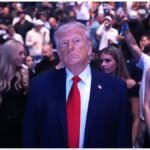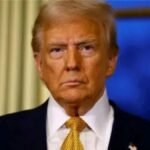

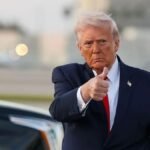

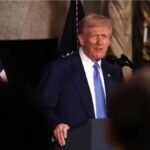


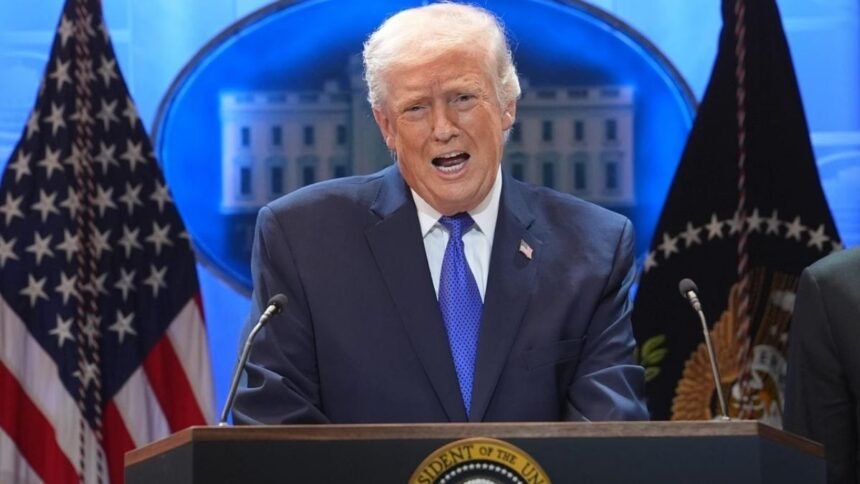
Donald Trump rarely passes up an opportunity to look confident on camera. The president, whose face has become one of the most recognizable in modern political history, has built his entire brand around projecting strength and certainty. So when his face went completely blank during a live White House event, the moment cut through the noise almost immediately.
It happened on June 11, during a bill-signing ceremony in the Oval Office. Trump had gathered fishing industry executives behind him to celebrate his administration’s rollback of environmental protections affecting large stretches of the Pacific Ocean. What looked like a routine, scripted policy moment quickly went sideways in a way nobody in that room seemed prepared for.
Before getting to the actual policy, Trump became fixated on gender terminology. He looked around the room, visibly uncertain, and began asking questions he clearly did not know the answers to. It was the kind of unscripted moment that reveals a lot more than any prepared speech ever could.
“So, tell me, how do they define that?” Trump asked aloud. “Because in most industries, like you have policemen, you call them fishermen and fisherwomen. I haven’t heard of that one before. How are the women? Do they want to be designated as fisherwomen? Does anybody want to answer that question?”
The room grew visibly awkward. He was not speaking with authority or making a point. He was begging others to speak for him, scanning the faces around him for someone who might rescue the moment.
One official jumped in and suggested the word “fisher” was the politically correct alternative used in the industry. Trump immediately mocked the idea, asking, “How about fisherpeople? These people are crazy.” The crowd offered a few nervous laughs, but the damage was already done.
Then things got even stranger. Another official admitted he had actually Googled the answer on the spot and found that many women in the fishing industry still preferred the traditional term “fishermen.” Trump did not thank him for the on-the-fly research. Instead, without missing a beat, he issued a warning that left several people in the room visibly uncomfortable.
“Well, be careful,” Trump said flatly. “That might be the end of your career.”
The moment went viral almost instantly. Clips spread across every major platform within hours, and social media users were not kind. The criticism was sharp, specific, and it came from all directions.
Trump having a totally normal conversation about gender in fishing where another adult has to tell him that people who fish are just called fishers. pic.twitter.com/i2JQamSPHb
— USNewsFeed (@USNewsFeed_) June 14, 2026
A Threads user remarked, “Trump having a totally normal conversation about gender in fishing where another adult has to tell him that people who fish are just called fishers.” The post gained traction fast, with thousands of people sharing it alongside their own reactions. Someone else summed it up in four words: “This is like an SNL skit!”
One critic pointed out the deeper irony of the whole spectacle. “He should have asked that before bombing the fishing industry right out of the Caribbean,” they wrote. The comment struck a nerve with people who felt the event itself was built on contradictions.
Others turned their attention to the people standing behind Trump in the room. “God, I just hate the way people are always overly laughing and fake happy in his presence,” one person said. “Not one ounce of shame in any of them. Nauseating.”
“Wtf is wrong with him and the people around him,” another stated. The sentiment echoed widely across comment sections and reply threads throughout the day.
“Huh? Gotta love the man at the end mansplaining how women feel,” someone else wrote. That particular comment hit hardest with audiences who have followed Trump’s long and complicated history with gender politics.
For many observers, the exchange felt like far more than just an awkward moment caught on camera. It felt like a window into a very specific pattern of behavior. Trump has long faced serious accusations of sexism, and critics argue that his instinct to mock gender-neutral language while simultaneously not knowing the answer himself reveals something important about how he views women in professional spaces.
His “Make America Great Again” slogan has consistently been interpreted by opponents as a coded message about returning to a time when traditional gender roles went unquestioned and unchallenged. Events like this fishing ceremony give those critics fresh material to work with, and they rarely waste the opportunity.
After the gender detour ran its course, Trump pivoted back to the policy that had brought everyone into the room in the first place. He signed an executive order opening up waters west of Hawaii to commercial fishing, officially rolling back marine protected area designations that previous administrations had put in place. The room applauded on cue.
“When they destroyed your whole life and your family and your business, and everything else, did you ever think you would have somebody who would come along and save it?” Trump asked the group before putting pen to paper. It was classic Trump, framing himself as the rescuer in every story he tells.
But the viral moment from earlier in the ceremony had already overshadowed the policy itself. The clip of Trump scanning the room for answers was replaying on loop across news feeds while he was still in the building.
The incident also reminded longtime political observers of other Trump verbal stumbles that had made headlines in recent months. Earlier this year, while discussing military operations near Venezuela, Trump used a phrase that left viewers genuinely puzzled about what he was trying to say.
“We have the ‘water drugs,’ I call them the water drugs,” Trump said during a Fox News interview. “In fact, I think water fishing, I think almost anything where you have to get into a boat right now in that area would not be doing too well.” Nobody in the studio pushed back or asked for clarification.
The phrase “water fishing” spread across social platforms within hours, earning its own round of mockery and confusion online. It became yet another entry in a growing list of moments where Trump’s confidence and his actual grasp of the subject seemed to be running in completely opposite directions.
That episode came just months after Trump confidently told an audience that he had personally invented the word “equalize,” calling it “the best word.” Merriam-Webster and several other major dictionaries noted publicly that the word had been in use since at least 1599, more than four centuries before Trump announced his discovery.
The fishing ceremony on June 11 fits neatly into that same running story. A president who never seems to doubt himself on camera found himself on live television with a completely blank expression, openly searching the room for someone who might know the answer he did not have.
In the end, it was not the fishing industry executives standing behind him who looked uninformed or out of their depth. It was the man at the center of the room, asking the questions, and quietly waiting for someone else to fill the silence he had created.