






Every word in that title tells a story, and viewers who watched President Donald Trump struggle down the stairs of Air Force One on Monday were left asking serious questions. They were asking about his legs, his declining mobility, and what his aides were so frantically trying to hide from television cameras. The moment did not feel like an isolated incident. It felt like a deeply familiar pattern that has finally become too visible for anyone to ignore.
The White House publicly confirmed last year that Trump has been diagnosed with chronic venous insufficiency, a circulatory condition that affects blood flow in the lower extremities. The condition causes blood to pool in the lower legs and ankles, producing the visible and sometimes shocking swelling that has appeared in recent photos and videos. That medical disclosure has done absolutely nothing to calm the growing public concern surrounding his overall physical health. If anything, the new footage from his European trip has pushed the conversation to an entirely new level.
Trump, now 80 years old, has become the subject of persistent and increasingly serious scrutiny every time he appears outside the safety of a seated environment. His administration has worked hard to shift the national conversation away from these repeated and alarming visuals of the president. Each new public appearance seems to add more questions rather than provide any reassuring answers. And his latest international trip gave critics, medical observers, and everyday Americans a great deal of fresh material to examine closely.
Trump landed in Geneva, Switzerland, on June 15 to attend the G7 Summit, arriving after an exhausting 11 to 14-hour transatlantic flight aboard Air Force One. The summit itself was being held in the French resort town of Évian-les-Bains from June 15 to 17, one of the most high-profile diplomatic gatherings of the year. After the presidential aircraft touched down in nearby Switzerland, Trump’s exit from the plane quickly became the dominant story coming out of the trip. What should have been a confident display of American presidential power turned into something far more troubling to watch.
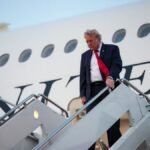
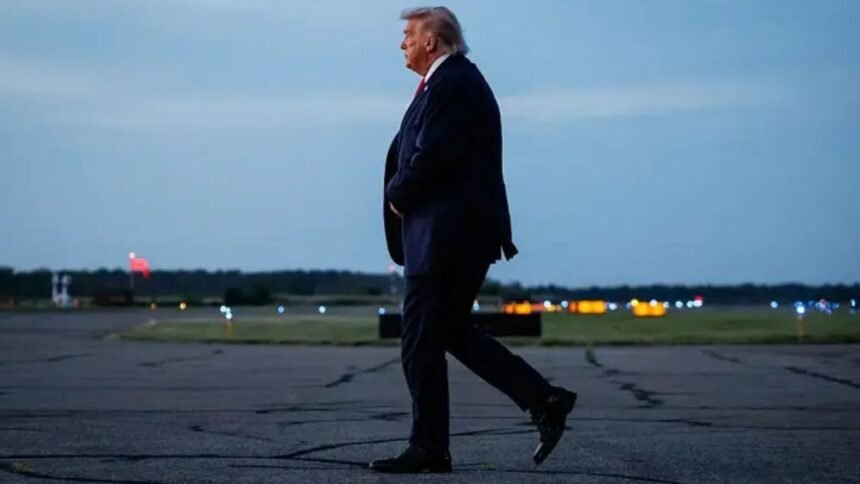
He came down the stairs of Air Force One gripping the railing tightly, his knuckles clearly visible in footage captured by multiple cameras on the tarmac. His descent was slow, stiff, and deliberate, with Trump appearing to move forward on his tiptoes as though carefully steadying his entire body weight with each individual step. His movements suggested something well beyond ordinary jet lag after a long international journey. For many who watched the footage closely and in real time, the visual raised immediate and serious concerns about his physical condition.
Eagle-eyed viewers who zoomed in on the video noticed something immediately alarming about his lower body and specifically his legs. Trump’s ankles appeared visibly swollen, unusually thick, and noticeably enlarged compared to footage from earlier public appearances this year. That striking visual reignited fresh and urgent concern about his chronic venous insufficiency and whether the condition is worsening over time. The images spread rapidly and widely across every major social media platform within just a few hours of his Geneva landing.
View on Threads
Social media users reacted with a combination of shock, humor, and genuine alarm. One person wrote plainly, “Look at the size of his ankles,” and the comment was liked and reshared thousands of times across platforms. The post quickly became a rallying point for people who have long questioned whether Trump’s presidential health disclosures have been fully honest and transparent. It was precisely the kind of viral moment the White House communications team had worked hard to prevent.
Other reactions leaned sharply into mockery and online humor. One user typed, “Those ankles are looking mighty thick,” while another kept it brutally short with just three words: “Clomp…clomp…clomp.” A third reminded the internet of his widely recognized physical nickname, writing without hesitation, “And look at those cankles!” The comment sections across Twitter, Threads, and Facebook filled up with thousands of responses within the first hour alone.
A separate and more serious group of users shifted their concern toward his broader physical appearance and overall weight. One person asked directly, “Is it me, or has he put on like 125 lbs since I saw him standing last.” Another added with sharp wit, “He looks like he’s gained 30lbs in the last month. Could be medication-related in addition to his McDonald’s fetish.” These were not quiet, fringe remarks but widely shared observations that drew massive online engagement and news coverage.
This is far from the first time that Trump’s physical mobility and fitness for office have triggered a sustained national conversation. He has been captured on video multiple times moving slowly and gripping railings tightly while descending stairs at the White House, on foreign tarmacs, and at campaign events. Every clip has been shared widely and has become part of an undeniable body of evidence that raises real questions about his physical capacity as commander in chief. The pattern stretching across months and locations is now far too consistent to brush off as occasional tiredness.
What makes this moment cut especially deep is how sharply it contrasts with Trump’s own past statements about physical fitness and stair-climbing. Last April, speaking directly on CNBC’s “Squawk Box,” he launched an unprompted attack on former President Joe Biden’s ability to handle even basic physical tasks.
“He couldn’t walk a flight of stairs, forget about down, he couldn’t walk up a flight,” Trump said confidently on national television.
He then followed that pointed attack with a startlingly candid and self-aware admission about his own physical limitations. “I have to be careful because if I do trip or fall, it’s gonna be the biggest story.” Those words have since taken on a meaning far heavier than when he first spoke them.
“That’s why when I get out of those planes, I walk nice and slowly,” Trump also admitted during the same interview. “I’m not looking to set any speed records.” His own carefully chosen words have now become the most accurate caption available for every slow-descent video the cameras keep capturing.
That admission reads in a completely different light now after what the entire world watched unfold on the Geneva tarmac on Monday. Critics were swift to connect the dots between his past mockery of Biden’s mobility and his own clearly visible struggles stepping off Air Force One in front of a global media audience. The irony was sharp, uncomfortable, and impossible to spin away. Even the most loyal supporters found it difficult to argue confidently against footage that speaks entirely and powerfully for itself.
The comparison to former President Barack Obama surfaced quickly and drew enormous engagement across every platform. Trump has spent years aggressively positioning himself as sharper, stronger, more energetic, and more physically capable than any of his predecessors, including Obama. But Obama’s image of natural physical ease, athletic confidence, and graceful public movement has always been an extraordinarily difficult standard for Trump to credibly match. Monday’s footage only deepened that contrast in the most public way possible.
One social media user captured the comparison with striking clarity, writing, “Obama flew down those stairs. Like Gene Kelly,” referencing the legendary Hollywood performer celebrated worldwide for his effortless, fluid, and breathtaking physical grace on screen.
View on Threads
It is also worth noting that Trump almost never holds a press briefing, public meeting, or formal interview while standing on his feet. A chair is nearly always placed within immediate reach, and his public schedule is visibly structured around minimizing the need for extended standing or walking. That quiet but telling logistical detail has not gone unnoticed by journalists, medical professionals, or the millions of Americans who follow his public appearances closely. It has become one of the more quietly revealing patterns in how his team manages his day-to-day presence on the world stage.
The twice-impeached president now carries a long, well-documented, and publicly visible track record of cautious and labored movement whenever stairs are part of the scene. Viral videos have captured and amplified these moments relentlessly, and every new clip adds another chapter to the urgent national debate about his health transparency and fitness for the presidency. The Geneva footage is simply the most recent and most widely seen entry in a record that shows no signs of stopping. Monday’s images from the tarmac are now a permanent part of the public archive on Donald Trump’s presidency.
For the millions of Americans who have followed this story carefully and with growing concern, the scene in Geneva was not a surprise. It was, however, deeply hard to explain away, dismiss, or reframe through any political spin. The proof, as Trump’s own candid and remarkably self-aware words once warned it might eventually be, is very much in the pudding.