





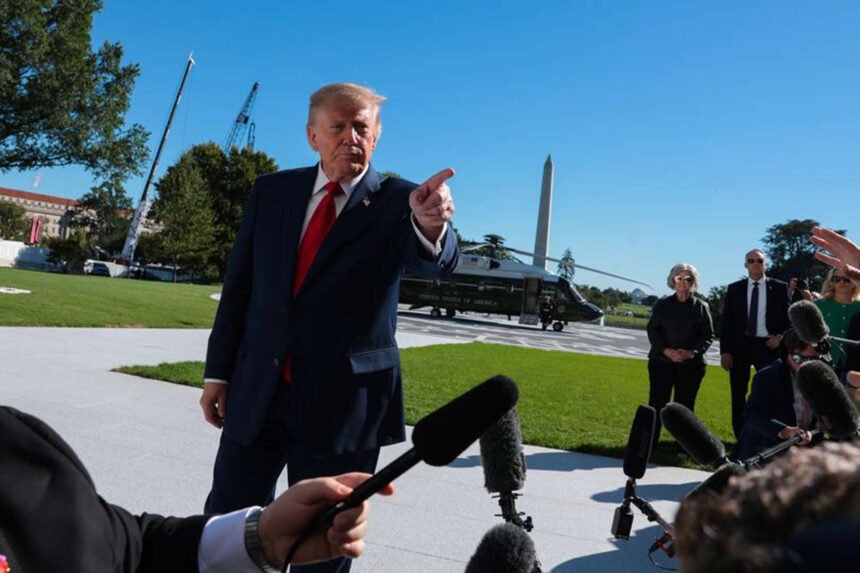
President Donald Trump lost control on Monday when he publicly humiliates a female reporter mid-question over a damaging poll. CNN’s Kristen Holmes began asking about his sharp drop among Latino voters. Then the insult he hurled gets leaked across social media, and nobody can believe a sitting president said it out loud in front of cameras.
Holmes tried to finish her question outside the White House. She noted that Trump’s approval rating with Latino voters had fallen to 27 percent. The president cut her off at once.
“No, no,” Trump said, shaking his head.
“You’re fake news. You’re CNN. You’re fake news.”
He insisted his own numbers looked strong. He pointed to the size of his crowds and claimed that candidates improve once he appears with them. The rant did not stop there.
“No. CNN’s poll numbers are fake, your whole outfit is fake and so are you,” he declared.
The word “outfit” usually means a set of clothes. In this case Trump used it to mean the entire news organization and the reporter herself. The personal jab landed hard.
Video of the exchange spread quickly. Viewers reacted with disbelief that a president would speak that way to a working journalist asking about public polling. One commenter called the moment a clear sign of detachment from reality. Another said it sounded like something a child might say on a playground. A third simply labeled the behavior despicable.
This was not the first time Trump has targeted Holmes. In August she asked about his decision to scale back joint military exercises with South Korea after he praised North Korean leader Kim Jong Un. Trump told her to be quiet and called her a “fake reporter.” The White House later posted a message that referenced her children and suggested her work would one day embarrass them.
The pattern stretches back years. Since Trump returned to the White House nearly two years ago he has repeatedly interrupted female reporters, questioned their motives, and criticized their appearance when the questions turned uncomfortable. The same approach appeared during his first campaign in 2015 and continued through both terms.
The latest confrontation arrives while the administration fights a legal battle over press access. CNN, MS NOW, and Politico sued after the White House barred them from the rotating press pool. A federal judge ruled on October 1 that the ban was likely unconstitutional and ordered temporary restoration of access. Even so, the administration has continued to limit CNN’s participation, including blocking the network from traveling with the president on a recent trip.
The poll numbers Holmes cited come from a fresh NBC News/Telemundo poll of 800 Hispanic registered voters. Only 27 percent said they approve of Trump’s job performance. Sixty-nine percent said they disapprove. Two-thirds believe his immigration enforcement has gone too far. Seventy-five percent disapprove of his handling of the economy and the rising cost of living.
Latino voters played a major role in Trump’s 2024 victory. Many of those same voters now appear ready to support Democrats in the coming midterm elections. The shift could help determine control of Congress. Recent surveys show Democrats leading among Latino voters by double-digit margins on the generic ballot question of which party should hold power.
Trump’s response to the data followed a familiar script. He rejected the numbers, attacked the messenger, and insisted the crowds he draws prove otherwise. Analysts note that crowd size at rallies does not always match broader public opinion measured by carefully designed surveys.
The episode highlights a deeper tension between the White House and the press corps. When reporters press for answers on approval ratings, policy outcomes, or shifting voter groups, the president often answers by questioning the legitimacy of the questioner. That approach keeps the focus on the conflict rather than the underlying numbers.
Holmes continued her reporting after the exchange. The poll she referenced remains publicly available and continues to shape discussion of the midterm landscape. Latino support that once boosted Trump now looks like a vulnerability that could cost his party seats in key districts.
Observers watching the exchange pointed out that a president who cannot tolerate a single sentence about unfavorable data risks appearing unable to confront uncomfortable facts. The leaked video of the insult only intensified that impression. For many viewers the moment confirmed what they already suspected: when faced with bad news, this White House prefers to silence the messenger rather than address the message itself.
The coming weeks will show whether the Latino shift holds and whether it translates into votes. For now the public record includes a clear exchange outside the White House in which a sitting president publicly cut off a female reporter, dismissed a widely reported poll, and ended by calling both the network and the journalist fake. The words remain on video for anyone to examine.