





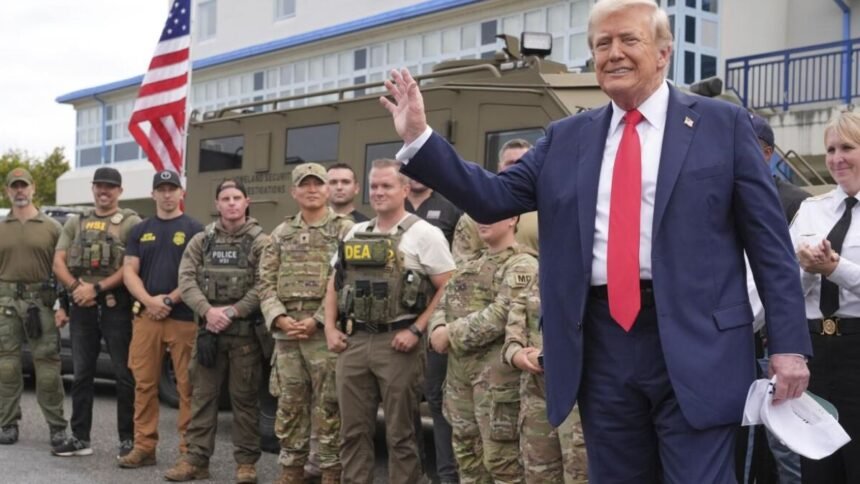
The U.S. Court of Appeals for the District of Columbia Circuit issued a unanimous stay of a lower court order that had blocked President Donald Trump’s deployment of the National Guard in Washington, D.C., allowing the troops to remain in place while the government’s appeal moves forward.
The three-judge panel included Judge Patricia A. Millett, appointed by President Barack Obama, alongside Judges Gregory Katsas and Neomi Rao, both appointed by Trump.
Judge Millett wrote in the court’s opinion, “Because the District of Columbia is a federal district created by Congress, rather than a constitutionally sovereign entity like the fifty States, the Defendants appear on this early record likely to prevail on the merits of their argument that the President possesses a unique power within the District — the seat of the federal government — to mobilize the Guard.”
This ruling effectively allowed more than 2,300 National Guard members from D.C. and eight states to remain deployed in the capital.
Judge Rao wrote, “We have never recognized that the District possesses an independent sovereignty that can give rise to an Article III injury from actions of the federal government.”
Context
U.S. District Judge Jia Cobb ruled that President Trump exceeded his authority by deploying the National Guard in Washington, D.C., finding the use of troops for general crime control and the activation of out-of-state units unlawful under District and federal law.
She stayed her order to halt the deployment to allow the administration to appeal. D.C. Attorney General Brian Schwalb then filed an appeal, arguing that the White House needed consent from local officials, including Mayor Muriel Bowser.
Schwalb emphasized that the appeals court’s decision to pause the lower court’s ruling did not resolve the underlying legal issues and pledged to continue the legal fight. The dispute unfolded as a West Virginia Guard member, Spc. Sarah Beckstrom, was killed and Staff Sgt. Andrew Wolfe was seriously injured in an ambush near the White House; in response, the administration announced plans to send additional Guard members to the capital.
Broader impacts
The appeals panel emphasized that Washington, D.C.’s unique status as a federal district — not a sovereign state — was central to its analysis.
The judges noted that interpreting the law to allow National Guard units to be sent into a non-consenting state for law enforcement purposes would raise serious constitutional and federalism concerns.
Writing for the court, Judge Millett warned that compelling an out-of-state Guard into a state without consent could undermine the constitutional balance between the federal government and the states. The ruling contrasted with a separate dispute over President Trump’s attempted Guard deployment in Chicago, which remains blocked as it continues through the courts.
What the stay means on the ground
The appeals court ruled that the National Guard may remain in Washington, D.C., while the legal challenge proceeds. Current deployment orders show the Guard could stay there through at least the end of February 2026 unless another court changes the order.